It’s a common and yet nightmarish scenario for any child of divorce: one parent has left, and the other assumes that they can invite a near-stranger to live with you and it will be just cool I promise, you’ll get along great.
Ji-Won is a university student. Her mother, her Umma, has crumpled from their father leaving her, leaving Ji-Won with the responsibility of looking after both her and her fifteen year old sister, Ji-Hyun. When her Umma begins to date another man, an older white guy named George. Ji-Won immediately takes a disliking to him, and as things develop her dislike is justified. George clearly fetishizes Asian women, and it seems that the three of them are no exception.
While balancing new friendships and moving past the friendships that she herself has destroyed, the titular aspect of the novel slowly comes into focus; Ji-Won slowly develops an obsession with eating eyes. Not just anyone’s eyes, but blue eyes belonging to white men.
Spoilers ahead.
“men be like that”
Toxic masculinity was a huge conversational aspect of the book. Author Monika Kim investigates this in the form of three male characters; the father of Ji-Won, George, and another classmate named Geoffrey.
Ji-Won’s father haunts the narrative, almost never appearing in text but his presence is always felt. Or rather, his lack of presence. The grief that the sisters and their mother feel at the divorce is palpable. He represents a very typical kind of patriarchal masculinity that feels very traditional. He doesn’t speak about his feelings, he keeps his thoughts and motivations close to his chest, and his wife contorted himself into any position that he asked of her, yet it still wasn’t enough.
George is in a way the villain of the story. He is loud and boisterous, he has a fascination/fetishizing interest in Asian women, and he thoughtlessly takes up space. His entitlement is almost cringeworthy, and you can feel yourself wince as he plops himself down into whatever scenario he finds himself in. He is manipulative with a mean streak, and his downfall comes from underestimating Ji-Won. His character has a surprising amount of room to breathe, however, and is well developed. It would be easy for a character of his archetype to be caricatural, but Kim spends the required time needed to develop his motivations and complexities.
Lastly, Geoffrey is the classical “nice guy”. He just wants to be friends, you know? He can quote Ruth Bader Ginsberg and and wears t-shirts with feminist quotes on them. At first, Ji-Won is struck by how good he is at listening. Of course, this devolves into possessiveness, an irritable temper, and the red flags that anyone of a younger generation can recognize in this particular breed of men from the pseudointellectualism to the anxiety that you get while talking to them that they could fly off the handle at any moment.
So are there any female foils to these characters? Not so much, actually. Ji-Won’s character is very in her own head. She has her own secrets and motivations, and she does not bring any other characters in on her plans. Ji-Won is not a “girl’s girl”. She loves her sister and her mother, but she stabbed her own high school friends in the back and drove wedges between them when she failed to get into the same university. She has her own selfish motivations and trusts her secrets to nobody. She befriends Alexis, and there is undoubtedly a homoerotic tension between the two girls, but she ultimately does not trust her.
This book does not follow the “female relationships can save you” story. Don’t doubt for one second that Ji-Won is a bad person. You’re rooting for her, and you are definitely invested in her, but she is not a hero. Her motivations are selfish, her methods are cruel, and in the end you have no doubt that this is a prequel to a life filled with violence.
the obsession
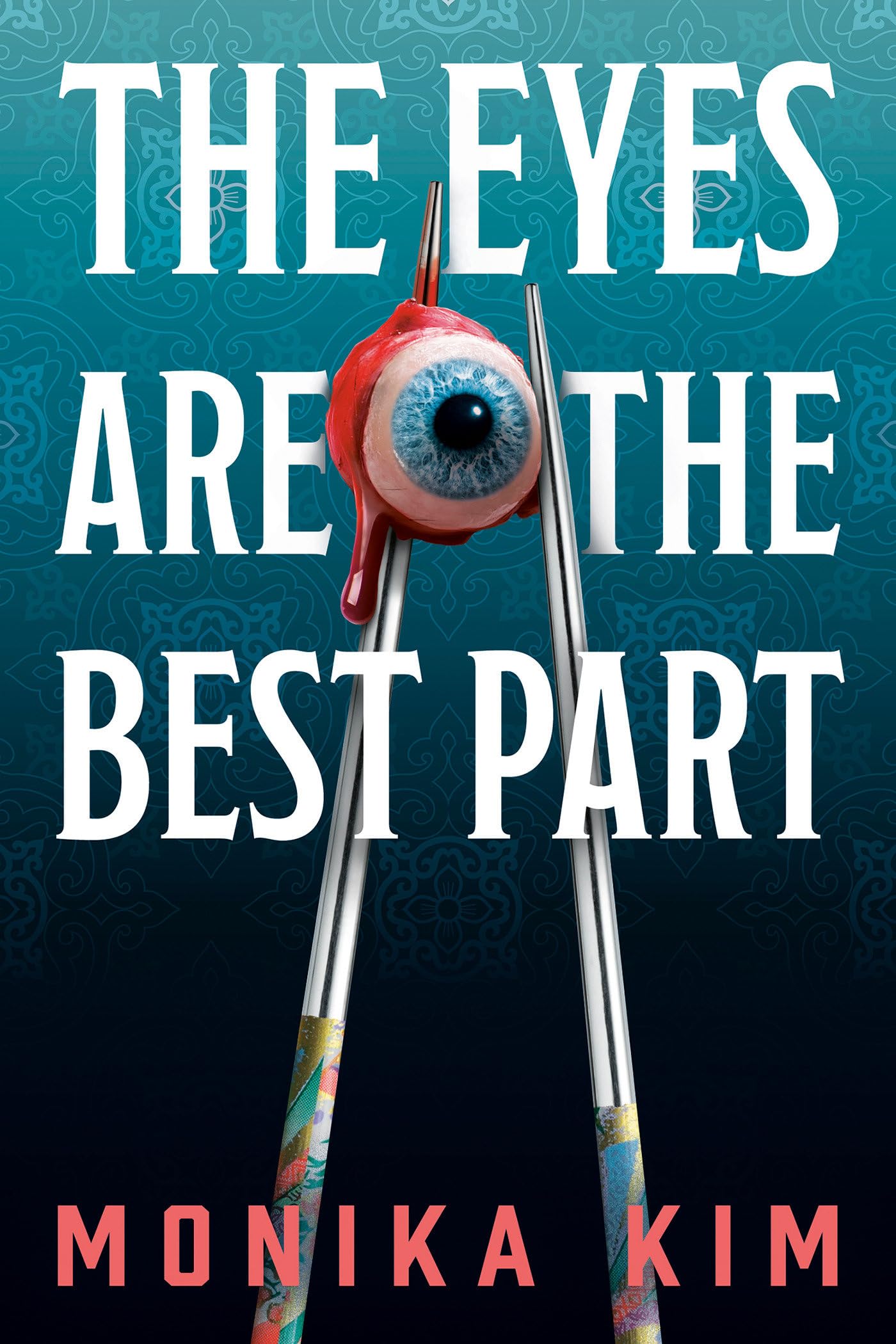
The cover of the book is fantastic and is definitely why I picked it up to begin with.
This book delivers on its premise in a spectacular, gory, visceral way. I listened to it as an audiobook, and I had to kick some of the parts up to 2x speed because sitting in them for too long was making me nauseous. Kim does not waste any detail describing what it’s like when Ji-Won finally gets to consume an eye for the first time.
The book gets kicked into high gear when the dreams and fascination with George’s eyes turn into a horrible reality come true when she finds a dead homeless man, plucks out an eye and eats it. It is intensely graphic, and brings the book’s atmosphere from a tone of dread and suspense to the world of splatter gore.
The concept of eating white men’s blue eyes is obviously culturally and socially loaded. You can almost see a sense of internalized racism in certain parts of Ji-Won’s speech when she talks about how brown eyes would taste like mud, but blue eyes would taste delicious. Cannibalism is always symbolically loaded— who consumes and who is consumed?— and to turn the consumption of the bodies of Asian women by white men on its head in a literal sense is an extremely fun space to play in. In interview, Kim talked about how “Almost every Asian woman I know has had to deal with some aspect of our hypersexualization and fetishization in popular culture” (Kim to Library Journal, 2024) and how this book outwardly challenges narratives of Asian women being submissive, Asian kids being good in school, and other breaks from the concept of the model minority. Ji-Won feels isolated from her own culture as well as the dominant culture in America, which puts her in a perfect position to become monstrous.
what it means to hunger
Hunger is another core concept in the story. Ji-Won’s mother endures an intense period of starvation in Korea during a time of famine. There is less literal hunger— for power from Ji-Won, for validation from her Umma, the coveting of female bodies from the men in the story.
Ji-Won’s hunger for revenge becomes physically intertwined with her hunger for George’s eyes. It is an all-consuming obsession.
The novel conflates desire of the mind and soul with nourishment for the body, which is something I always enjoy. It also feels extremely poignant that the food in question for Ji-Won is eyes. Fish eyes, as mentioned in the book, are consumed in many cultures. It is a common experience for immigrants to experience harassment for traditional foods, perpetrators often citing strong smells or that it’s “weird”. Kim takes the power back from this narrative in a way that feels like “so what? fuck you” and I really enjoy that. She pushes the weirdness of the story, and the weird factor is one of its strongest parts.
The Eyes are the Best Part asks the viewer about hunger, consumption, and revenge. It gives us a protagonist who takes things to the extreme, but we still find ourselves rooting for her. It’s a bloody romp that will make your stomach queasy and then question why this particular nerve has been struck. Read at your own risk, hard boiled eggs will never taste the same.