My first advice for anyone who is interested in watching Weapons is to skip reading the reviews and go give it a shot. All you need is the poster.
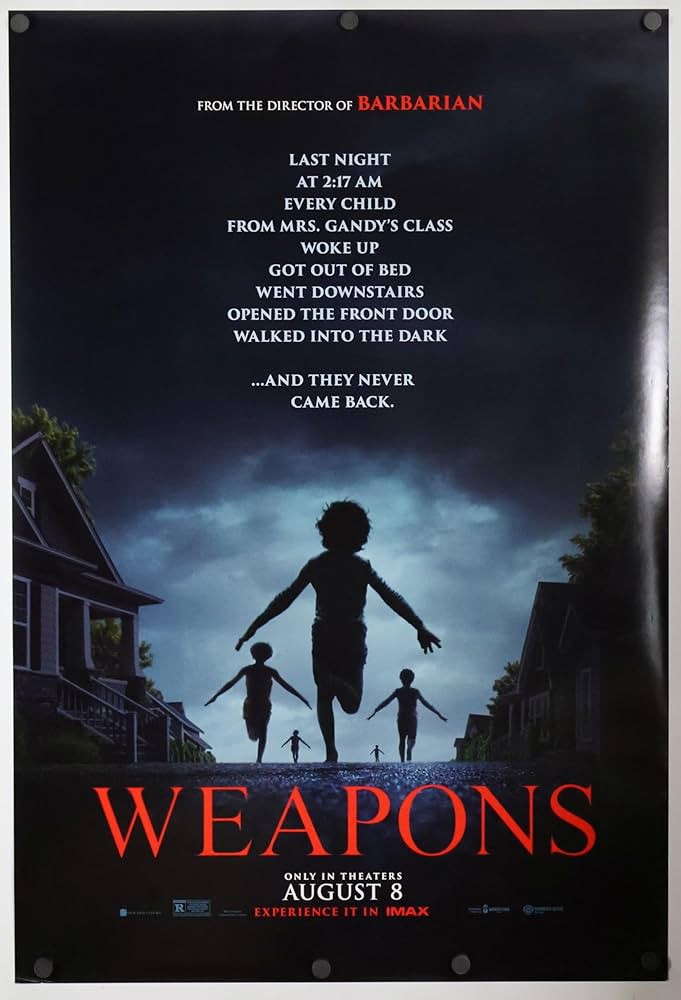
Weapons is a great movie that builds off of an intriguing concept, haunting visuals, and has a lot to say about how communities work and change after tragedy, as well as commentaries on mob violence and familial dynamics. After Zach Cregger’s other film Barbarian, I knew to go in cold and expect a wild ride. I recommend you do the same if you haven’t already.
This is the spoiler point of no return.
There is no slicing or dicing with this film. They deliver on the promise of the premise within the first minutes as the unnamed child narrator tells us that seventeen children have disappeared. We watch them get out of their beds, and run into the night with their arms out as though they are flying. The rest of the movie is now dedicated to answering the two questions: why did they leave, and where did they go?
Some key details. This is a contemporary film; several of the children were caught leaving on the home security footage of the different houses. Nobody forced the children to leave, they just ran out into the night. Only one child did not disappear; a boy named Alex was the only one to show up to class the next day.
Summary
The film then follows the perspectives of several characters in discreet blocks with title cards, showing us the same events happening from different perspectives and slowly giving us more information over time.
The first is Justine Gandy, the teacher whose entire class save one vanished. She is revealed to be on the knife’s edge psychologically, the parents of the town rallying in a type of witch hunt around her, determined that she may know the cause of their children’s disappearances. She knows nothing, drinks too much, and after being stalked she finds that her car has been painted with the word WITCH in red house paint.
Archer Graff is the grieving father of one of the missing children. He is determined to find out what happened to his child. He watches the footage that their security camera caught obsessively, and he realizes that his child is heading in a specific direction, towards a destination, and is able to use another family’s security footage to figure out that their children are heading on a similar trajectory. He believes Justine Gandy knows something she isn’t telling, and he was the one to paint WITCH on her car. However, his tune changes when she is attacked by the school’s principal, running towards her in the same way that his child was running on the security camera footage.
The film also follows Paul, a police officer who sleeps with Justine Gandy and harasses and pursues James, a drug user who ends up seeing too much. Justine first investigates the house of Alex, the boy left behind, and sees that the windows are covered and she can see two figures sitting stock still in the living room through a crack in the paper. Archer and Justine have prophetic, haunting dreams of this house and what happened to the children. James breaks into the house on the search for things to steal and sees the two people sitting on the couch, not reacting even when he takes their possessions. He finds the children standing in the basement, not reacting in a similar way, as though they were mannequins. He convinces Paul to investigate the house when they meet again, and the two of them never emerge from the house again.
The most upsetting sequence for me was where we follow Marcus Miller, the principal of the school who we know attacks Justine later. He is a kind man, who follows things by the book, and when Justine insists he does a welfare check on Alex, calling a guardian into the school to talk.
This is our first true look at Gladys, who is seemingly Alex’s “aunt”. I say “aunt” because really who knows, but for all intents and purposes sure. Gladys is definitely suspicious, and when she pays Marcus and his husband a visit we finally get a glimpse into the how and why aspect of the film. Gladys, using a branch, her blood, and an item belonging to Marcus, is able to put him into a mindless state and force him to kill his husband in an extremely gruesome scene. She then uses a lock of Justine’s hair to force Marcus to “target” her, and he goes running into the street to attack her, bringing us back to Archer and Justine’s initial confrontation. Marcus meets his fate when he is struck by a car. Archer and Justine must now face that something otherworldly is going on, and they join forces to figure out what’s happening.
This is finally when we get Alex’s perspective. We see that he has loving parents prior to the arrival of Gladys, who over the course of one school day is able to gain control of them. They never speak another word throughout the film, only serving as unspeaking puppets to Gladys. She forces them to stab forks into their faces to prove to Alex that she can control them absolutely. The most heartrending part of the film is watching this small boy deal with the fear of this relative invading his home while he is also put in the position of having to feed his parents by hand.
Of course, Alex is persuaded to steal the nametags from his classmate’s bins in order to allow Gladys to control them. He watches with horror as she summons them into their home, and he knows that there is nothing he can do to save them. So all he can do is play along and wait.
His opportunity comes when Justine and Archer finally go to investigate the house, which leads to a spectacular confrontation where Paul and James are puppeteered into attacking them once the salt boundaries are crossed. The climax of the film is filled with action, which culminates with Alex himself harnessing the witchcraft that Gladys has been using and turns the mob of children against her. The scene where they chase her through the suburbs is utterly spectacular, and you can’t help but cheer as she is torn apart with their bare hands.
The spell is not exactly broken, but when Archer chases after them and finally finds his son, his son turns his head to acknowledge him, signaling that at least some of the magic has been dissipated. Alex’s parents never return to normal, and the children are still shells of themselves, but the narrator returns to tell us that some of the children have finally begun to speak again.
Technical stuff
From a technical standpoint, I really enjoyed it. The acting was great, the setting felt very real, and there was some excellent camera work and a very good score. The pacing was intriguing and kept things moving, and at the end I felt very rewarded for my investment. Sometimes films like this don’t feel the need to solve the mystery, but I am very happy to say that this doesn’t apply here. At the same time, it wasn’t all tied up in a nice little bow, which I appreciate because in a real life tragedy, not everything gets resolved.
I definitely plan to rewatch this at some point so I can try to catch the hints about what is happening that the film puts down earlier.
So what’s the movie trying to say?
Some themes jumped out at me immediately, others came to light slowly as I digested my viewing experience.
The first one I’ll touch on was not the one that immediately came to mind, which for me I attribute to being not American. The school shooting metaphor is the forefront, right down to the name of the film. This is a movie about what happens to a community after a tragedy hits in a school setting. The reactions of the community from creating memorials to angry parents demanding how this could have happened and whether the teacher saw any signs all ring very true for how these real life scenarios of violence play out.
It’s a commentary on American gun culture, even though physical guns only appear twice in the film. We see an AK-47 in a dream sequence in Archer’s mind, appearing above his own house and pointing into the dark. We see a gun at the end, when Justine shoots Paul and James to stop their rampage. Instead, human beings themselves are turned into the weapons, brought to a bizarre and animalistic state where they can be compelled to do terrible things, their minds separated from their bodies. You can almost imagine their psyche as something similar to the sunken place in Jordan Peele’s Get Out, their minds trapped inside their bodies as they perform these horrific barbaric acts of violence.
I also picked up on the “witch hunt” aspect. Justine Gandy is heckled and harassed, but she is not the true witch in the film. Mob violence is a symmetrical element, with there being a parallel to how the parents chase Justine Gandy to her car at the start of the film mirrored by the way the mob of children chase Gladys at the end and tear her apart.
The director Zach Cregger has tangoed with elements of violence against women and toxic abuse cycles in his previous work, Barbarian. In that film, if you haven’t seen it, Cregger tackles questions about who is the true monster, as well as how women vs. men behave in monstrous situations. In Weapons, the question is less gendered and is more about how communities treat people who are different. Alex is a quiet kid who is bullied, so nobody really notices when he begins to be shy and reserved. Justine Gandy dresses alternatively and is divorced, making her an easy target for the ire of the masses when things go wrong. Marcus Miller is a gay man who tries to do things by the book, and his husband’s kindness towards Gladys is what ends up getting them killed. Gladys herself is an outcast in some ways, but also fuck that bitch. She was evil in a way that was fun to hate.
The themes of abuse definitely show their faces when we see Alex’s segment. It was haunting to watch a child completely lose all power in his life and have everything he cares about stripped away. It mirrors the real life reality that children who are abused often suffer, where their voices are silent and the authority figures that are meant to protect them are functionally unable to. It was the most haunting segment of the movie, and even though Alex was a boy of very few words you could see the gears turning in his head as he went through the motions of doing Gladys’s bidding. It had a strange Brothers Grimm or Roald Dahl vibe to it, as though it was a place out of time where children are regularly kidnapped by witches and are made to feed their parents and classmates Campbells soup.
Final thoughts
Probably my favourite scene in the movie was the cathartic moment at the end where we got to see Gladys be torn apart by children. It was fun watching her get chased down, and watching the kids burst through glass doors was extremely enjoyable. The movie had things it wanted to say, and it had heart. The mystery keeps you on the edge of your seat and the film knows when to scare you and when it’s time to make you wait and when it’s time to deliver on an action-packed sequence. It’s a movie with very contemporary themes that speaks to a lot of current cultural anxieties about children, the infiltration of the family unit, fear in our communities, and of course, fear of weapons that could be lurking in any home, ready to tear your own family apart.